
Arable Business Model: Transforming Precision Agriculture with Real-Time Crop Intelligence
Introduction
In the heart of Silicon Valley, a group of scientists and engineers set out to solve one of agriculture’s most pressing challenges: how can farmers make smarter decisions in an unpredictable world? Arable Labs, founded in 2014 by Adam Wolf, Kelly Caylor, and Ben Siegfried, emerged from Princeton University’s research labs with a bold vision—to bring real-time, field-level intelligence to every farm on the planet.
Adam Wolf, a plant scientist frustrated by the limitations of satellite data and outdated weather stations, teamed up with Caylor and Siegfried to create a new kind of sensor: one that could measure not just weather, but the actual health and growth of crops. Their early prototypes, known as “treePhones” and later “Pulsepod,” evolved into the Arable Mark series—compact, solar-powered devices that now dot fields in over 30 countries.
The market opportunity was clear. As climate change, water scarcity, and volatile markets put pressure on growers, the need for actionable, site-specific data became urgent. Traditional tools were expensive, fragmented, and often out of reach for small and mid-sized farms. Arable’s solution: an affordable, all-in-one device that combines weather, plant, and soil sensing with AI-powered analytics—delivering insights that help growers optimize irrigation, reduce risk, and boost yields.
Today, Arable’s flagship Mark 3 device is at the center of a global movement toward “decision agriculture.” With a recent $40 million funding round and partnerships spanning Fortune 500 agribusinesses, irrigation giants, and research institutions, Arable is poised to redefine how food is grown, traded, and sustained. Their mission aligns perfectly with the world’s growing demand for sustainable, resilient food systems—a market projected to reach $22.5 billion in precision agriculture by 2028 (MarketsandMarkets, 2023).
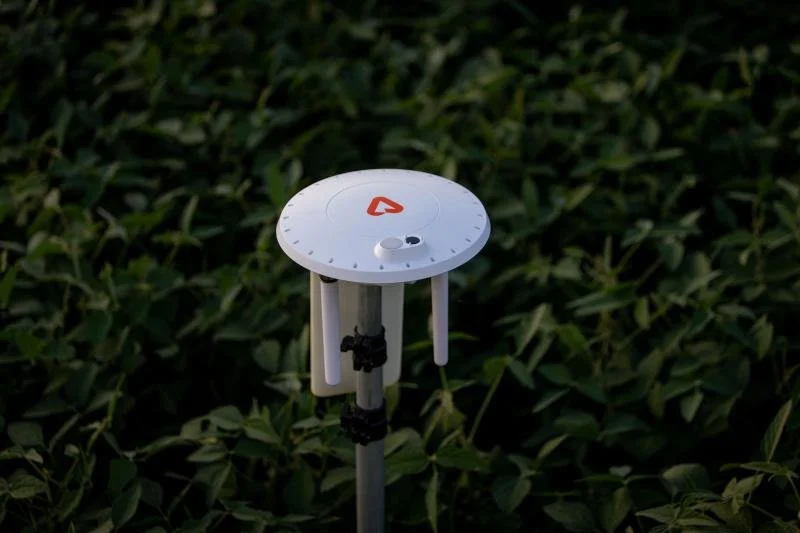
Image source: Arable Mark 3 Product Page
Introduce the IFAL Business Model Framework
At IFAL, we assess business model potential around four critical elements:
Value Proposition: Defines the core target customer/consumer segment and the key product/service attributes the targeted segment pays for.
Distribution Strategy: The revenue model offered to the channels through which the product/service is delivered to the target customer/consumer segment.
Complementary Partnerships: External alliances and interdependencies that are critical to produce and deliver the value proposition at optimal scale and profitable unit economics.
Sustainability Elements: Economic, social, and environmental outcomes delivered by the value proposition.
Target Segment & Value Proposition
Arable’s primary customers are progressive growers, agronomists, and agri-enterprises seeking to maximize productivity while minimizing risk and resource use. Their value proposition centers on delivering real-time, actionable insights—combining weather, crop, and soil data with predictive analytics to inform irrigation, fertilization, and harvest decisions.
Why do customers pay?
Precision: Field-level data, not just regional averages.
Simplicity: All-in-one device, easy installation, minimal maintenance.
Actionable Insights: AI-driven recommendations for water, nutrients, and crop health.
Risk Reduction: Early warnings for disease, drought, and yield variability.
Differentiated Attributes:
Integrated 5MP camera for crop imagery.
Solar-powered, rugged design (IP67-rated).
Seamless cloud platform (Arable Insights) for data visualization and alerts.
Affordable pricing and global scalability.
Competitive Advantage:
Arable’s unique blend of hardware, software, and data science—plus its focus on usability—sets it apart from legacy weather stations and fragmented sensor solutions.
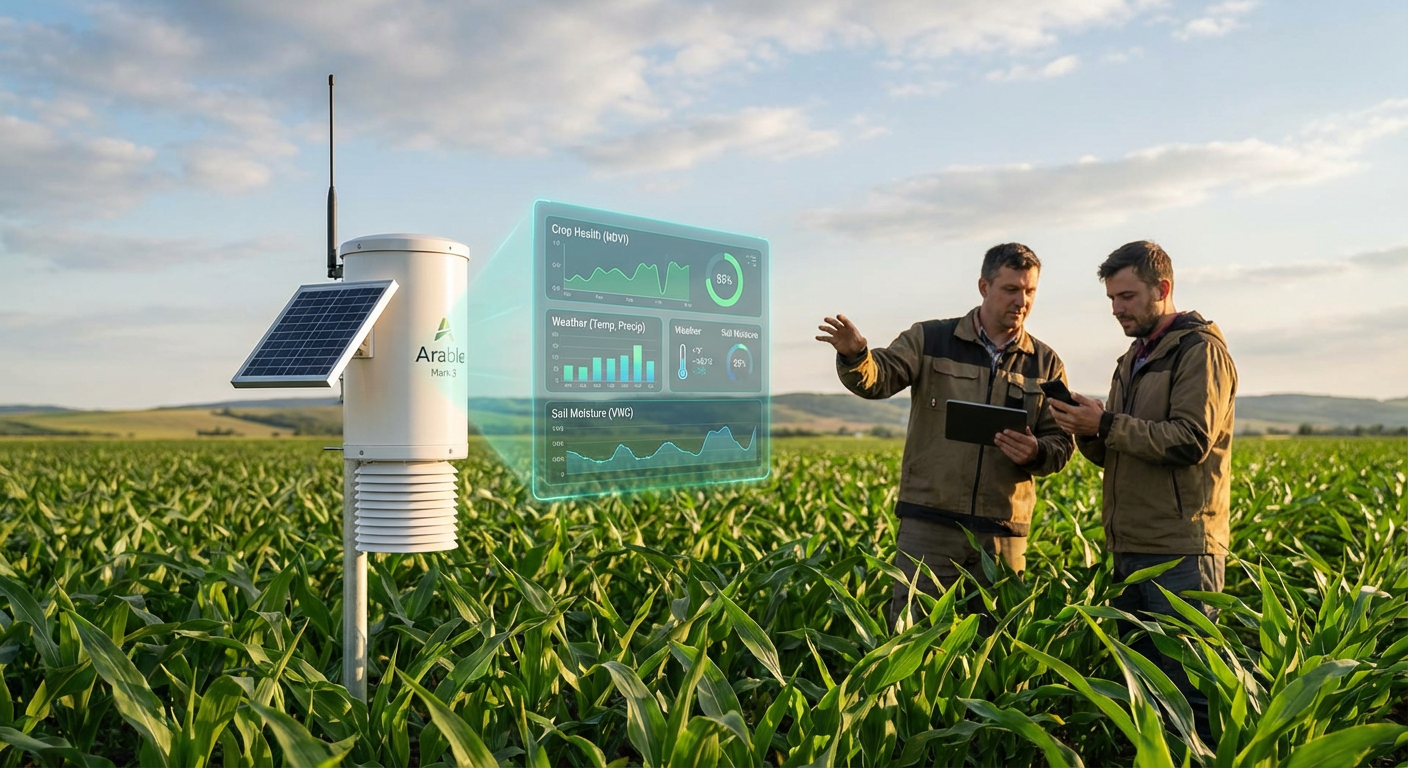
Illustrative of Arable’s value proposition—real-time, actionable insights for growers.
Distribution Strategy
Arable employs a direct-to-customer model via its website and sales team, complemented by channel partnerships with agribusinesses, irrigation companies, and agtech distributors. The company offers hardware-as-a-service (HaaS) and subscription-based analytics, making advanced crop intelligence accessible to farms of all sizes.
Current Go-to-Market Approach:
Direct sales to growers and agri-enterprises.
Partnerships with irrigation companies (e.g., Valley Irrigation) for bundled solutions.
Collaborations with research institutions and government agencies.
Potential Future Channels:
Integration with farm management platforms.
Expansion into emerging markets via local distributors.
OEM partnerships with equipment manufacturers.
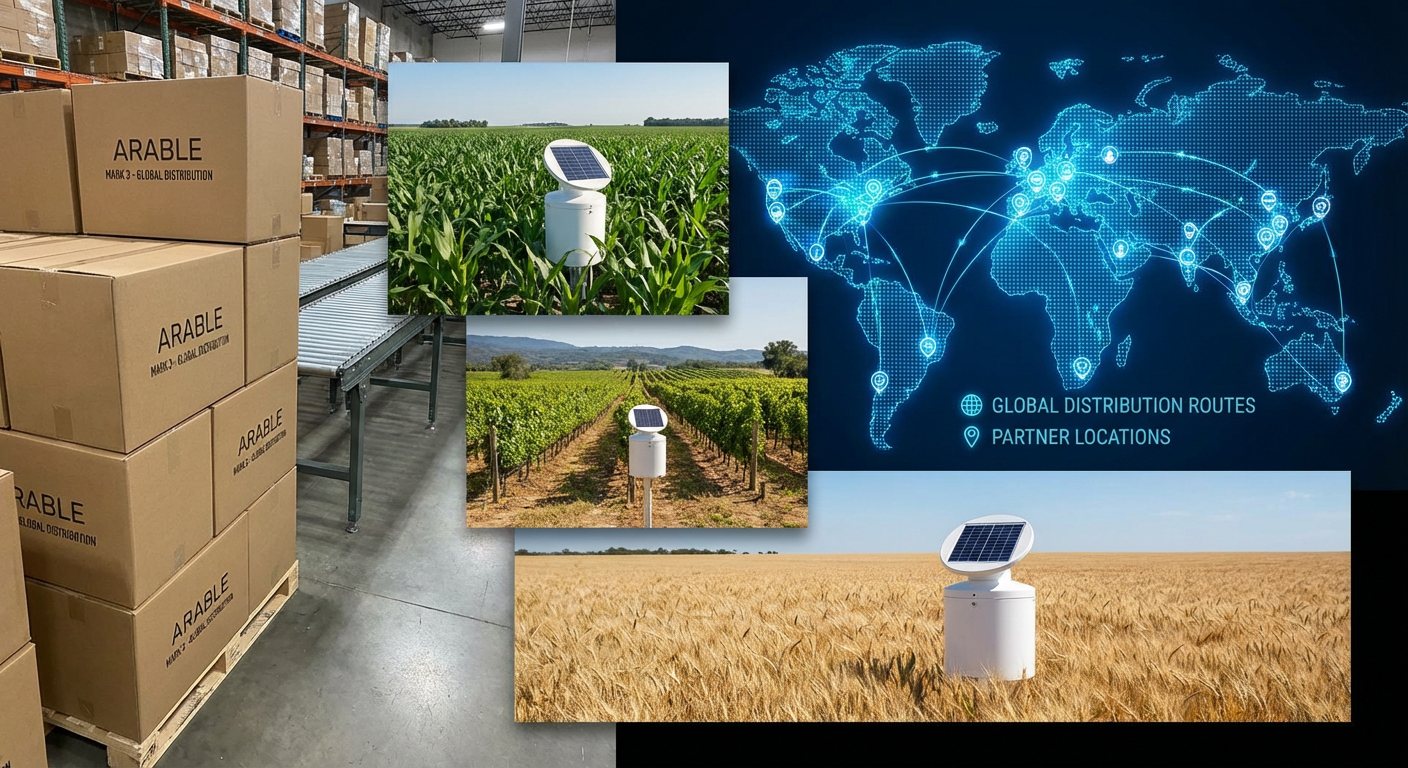
Illustrative of Arable’s global distribution and partnership strategy.
Complementary Partnerships
Arable’s business model thrives on strategic partnerships:
Irrigation Companies: Integration with Valley Irrigation and others to automate water management.
Research Institutions: Collaborations with universities and government agencies for product validation and innovation.
Agri-enterprises: Partnerships with large growers, food processors, and supply chain actors for end-to-end traceability.
Technology Providers: API integrations with farm management and analytics platforms.
These alliances enable Arable to scale rapidly, enhance its product offering, and deliver value across the agri-food ecosystem.
Sustainability at the Core of the Business Model
Sustainability is embedded in Arable’s DNA. By providing precise, field-level data, Arable empowers growers to:
Conserve Water: Optimize irrigation, reduce waste, and support water stewardship goals.
Reduce Inputs: Apply fertilizers and pesticides only when and where needed.
Boost Yields: Increase productivity without expanding land use.
Enhance Resilience: Adapt to climate variability and extreme weather.
Arable’s technology supports the UN Sustainable Development Goals (SDGs) for responsible production, climate action, and food security.
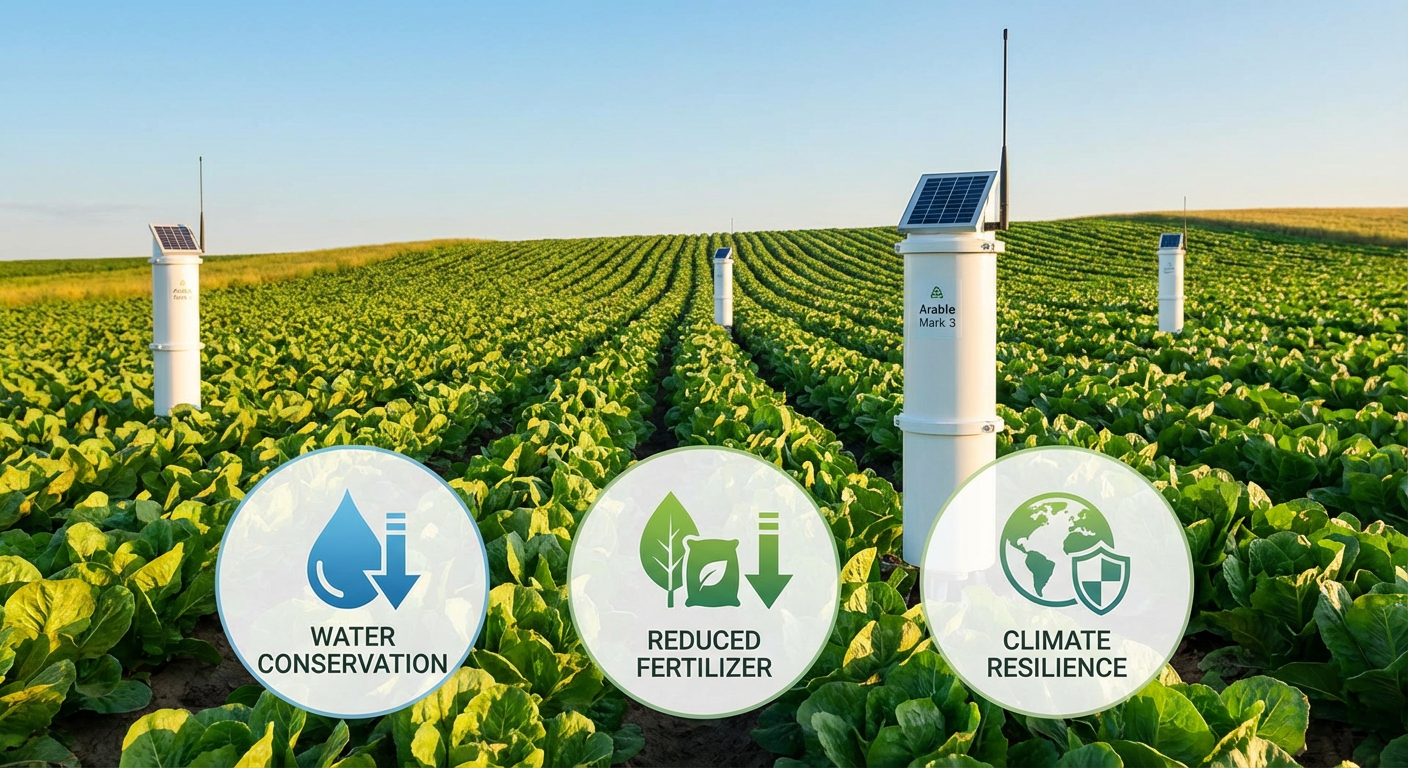
Illustrative of Arable’s sustainability impact in agriculture.
Strategic Dilemmas
Scaling Value Proposition: Ensuring device affordability and data reliability across diverse geographies and farm sizes.
Distribution Challenges: Managing channel conflicts and maintaining service quality as the network grows.
Partnership Complexity: Balancing proprietary innovation with open integrations and data sharing.
Sustainability Trade-offs: Addressing the environmental footprint of hardware production and electronic waste.
Key Takeaways
Arable’s business model leverages IoT and AI to deliver actionable crop intelligence.
The Mark 3 device offers a differentiated, all-in-one solution for growers and agribusinesses.
Strategic partnerships amplify Arable’s reach and impact.
Sustainability is central, enabling smarter resource use and climate resilience.
Key challenges include scaling, distribution, and balancing openness with proprietary value.
Continuing the Learning Journey
IFAL works with universities to deliver applied programmes for professionals and teams across food and agribusiness value chains.
You can explore our university partner programmes here, or connect with us here to discuss learning pathways for your organisation.
References
Disclaimer
This article is for educational and informational purposes only. We are not affiliated with or endorsed by Arable or any company mentioned. All trademarks and images are the property of their respective owners, and readers use this information at their own risk.