
Gotham Greens Business Model: Urban Farming for a Sustainable Future
Introduction: The Gotham Greens Story
In 2009, three visionaries—Viraj Puri, Eric Haley, and Jenn Frymark—set out to revolutionize how cities grow and access fresh food. Their idea was simple yet radical: build high-tech greenhouses on urban rooftops to supply local communities with crisp, flavorful greens, regardless of the season. Gotham Greens was born in Brooklyn, New York, and quickly became a pioneer in urban hydroponic farming.

Gotham Greens’ founders Viraj Puri (back right), Eric Haley (left) and Jenn Nelkin Frymark II (front right). Image courtesy of Mark Weinberg. Image source: Greenhouse Grower
The market opportunity was clear: urban populations were growing, and so was demand for fresh, healthy, and sustainably grown food. Traditional supply chains struggled to deliver truly fresh produce to city dwellers, often resulting in food waste and a hefty carbon footprint. Gotham Greens addressed these unmet needs by growing leafy greens and herbs in climate-controlled, resource-efficient greenhouses located right where people live.
Today, Gotham Greens operates more than a dozen greenhouses across the U.S., from New York to California, producing millions of pounds of greens annually. Their products—ranging from salad mixes to basil and dressings—are found in major grocery chains and restaurants. As consumers increasingly seek local, sustainable options, Gotham Greens’ value proposition aligns perfectly with market trends highlighted in reports by the USDA and Nielsen, which show rising demand for local and eco-friendly foods.
Company Product Image
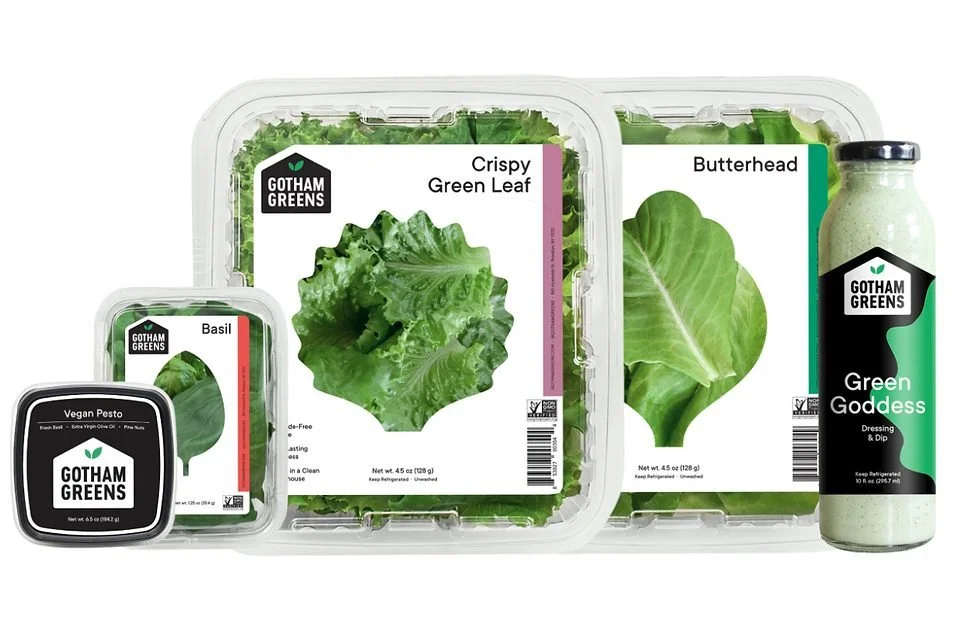
Image source: Gotham Greens website - Our Products
Introducing the IFAL Business Model Framework
At IFAL, we assess business model potential around four critical elements:
Value Proposition: Defines the core target customer/consumer segment and the key product/service attributes the targeted segment pays for.
Distribution Strategy: The revenue model offered to the channels through which the product/service is delivered to the target customer/consumer segment.
Complementary Partnerships: External alliances and interdependencies that are critical to produce and deliver the value proposition at optimal scale and profitable unit economics.
Sustainability Elements: Economic, Social, and Environmental outcomes delivered by the value proposition.
Target Segment & Value Proposition
Gotham Greens targets health-conscious urban consumers, grocery retailers, and foodservice businesses seeking fresh, local, and sustainably grown produce. Their value proposition is built on:
Ultra-freshness: Greens are harvested and delivered within hours, not days.
Sustainability: Hydroponic systems use up to 95% less water and 97% less land than traditional farming.
Local production: Grown in city-based greenhouses, reducing food miles and supporting local economies.
Consistent quality: Controlled environments ensure year-round supply and premium taste.
Their competitive edge lies in combining technology, sustainability, and proximity to market—attributes that resonate with modern consumers and retailers alike.
Distribution Strategy
Gotham Greens employs a multi-channel distribution strategy:
Retail: Partnerships with major grocery chains (Whole Foods, Kroger, Albertsons, etc.) ensure wide product availability.
Foodservice: Supplying restaurants, meal kit companies, and institutional buyers.
Direct-to-consumer: Select markets offer home delivery or local pickup.
Geographic expansion: Building greenhouses in new urban centers to serve regional markets efficiently.
This approach maximizes freshness, reduces logistics costs, and allows rapid scaling as demand grows.

Complementary Partnerships
Strategic partnerships are central to Gotham Greens’ success:
Retailers: Co-marketing and in-store promotions with grocery partners.
Technology providers: Collaborations for greenhouse automation, climate control, and energy efficiency.
Sustainability organizations: Partnerships with groups like Forest Nation for tree planting and environmental stewardship.
Local governments and community groups: Supporting urban revitalization and food access initiatives.
These alliances enable Gotham Greens to innovate, scale, and deliver on its sustainability promise.
Sustainability at the Core of the Business Model
Sustainability is woven into every aspect of Gotham Greens’ operations:
Water efficiency: Hydroponics uses up to 95% less water than field farming.
Energy: Greenhouses leverage renewable energy and advanced climate controls.
Reduced food miles: Urban locations mean less transportation and lower emissions.
Community impact: Job creation, education programs, and local food donations.
Gotham Greens’ B Corp certification underscores its commitment to balancing profit with purpose.
Strategic Dilemmas
Scaling urban greenhouses: High real estate and construction costs in cities.
Distribution at scale: Balancing freshness with logistics as the company expands nationally.
Channel conflict: Managing relationships between direct-to-consumer and retail partners.
Sustainability trade-offs: Ensuring renewable energy use keeps pace with growth.
Partnership complexity: Aligning incentives across diverse partners (retail, tech, community).
Key Takeaways
Urban hydroponic farming can deliver ultra-fresh, sustainable produce to city dwellers.
Multi-channel distribution and local production are key to Gotham Greens’ business model.
Strategic partnerships drive innovation, scale, and sustainability.
Sustainability is not just a value add—it’s core to the company’s operations and brand.
Scaling urban agriculture presents unique challenges but offers significant market and social impact.
Continuing the Learning Journey
IFAL works with universities to deliver applied programmes for professionals and teams across food and agribusiness value chains. You can explore Avila Agribusiness Programs (Powered by IFAL) or connect with us here to discuss learning pathways for your organisation.
References
Disclaimer
This article is for educational and informational purposes only. We are not affiliated with or endorsed by Gotham Greens or any company mentioned. All trademarks and images are the property of their respective owners, and readers use this information at their own risk.